
Weight-Loss Myths: Four Popular Ideas That Do Not Hold Up
Herbs that melt fat, faster is better, quit rice, one meal ruins the plan. Four popular weight-loss ideas checked against what health bodies and scientific reviews say.
By Eslam Abdelrahman6 min read

In this article
- In short
- Myth one: "There are herbs and drinks that melt fat"
- Myth two: "The faster the weight comes off, the better"
- Myth three: "I must give up rice and bread"
- Myth four: "I ate too much today, so I ruined the plan"
- What to do when you hear a new idea
- Why do weight-loss myths spread?
- What is left when the myths fall?
- Frequently asked questions
- Does green tea help you lose weight?
- Does slow progress mean I am doing it wrong?
- What if I overeat for a whole day?
- Before you start: when to talk to a doctor
- Myths and facts in a book
- Sources
People pass around many ideas about losing weight: a drink that does wonders, a rule that says faster is better, a food that must vanish from your table for good. Some of them cost you money, some wear you out physically and mentally, and some make you abandon your plan at the first slip. Here are four of the most widespread weight-loss myths, and what health bodies and scientific reviews say about them.
In short#
- There is not enough evidence that herbs and drinks lower weight by an amount that matters for health.
- Faster is not better; the pace health bodies recommend is half a kilogram to one kilogram a week.
- No single food makes you gain and no single food makes you lose. The answer is the portion, not the ban.
- One extra meal does not ruin your plan; giving up on all of it does.

Myth one: "There are herbs and drinks that melt fat"#
There is not enough evidence for this. A systematic review pooled 54 randomised trials with more than four thousand participants and found that herbal products used for weight loss did not lower weight by an amount that matters for health, compared with placebo. It concluded there is not enough evidence to recommend any of them.
Green tea, cinnamon and ginger are pleasant drinks when taken without sugar, but they do not melt fat and they do not replace the moderate calorie deficit we explained in How Weight Loss Works. Be wary of slimming products sold without a licence or from an unreliable source, and do not buy them. And if you take any medication, do not add an herbal mix without asking your doctor or pharmacist.
Myth two: "The faster the weight comes off, the better"#
Very sharp drops take from muscle and water, leave you hungry and tired, and the weight returns at the first slip. The pace recommended by the NHS and US health guidance is roughly half a kilogram to one kilogram a week. Slower than that is also normal, because bodies differ.
There are also minimum calorie levels that should only be gone below under medical supervision. Anyone who starves themselves to get past those limits gains nothing but exhaustion.
Myth three: "I must give up rice and bread"#
No single food makes you gain weight and no single food makes you lose it. What decides your weight is the total of what you eat over time. Banning a food you love has you thinking about it all day, and then eating too much of it the day you slip. The answer is the portion, not the ban: a fist of rice with half a plate of vegetables and a palm of protein is enough, as we set out in Healthy Gulf Food: The Plate Method.
This applies to kabsa, mandi, dates and sweets: all of them fit in a measured portion. If you have diabetes, ask your doctor what portion suits you.
Myth four: "I ate too much today, so I ruined the plan"#
One extra meal does not raise your weight in any real way. What raises it is deciding the whole week is lost and giving up. The most useful rule: the next meal is a normal one. No making up with harsh fasting and no punishing with hunger. Go back to your usual plate as if nothing happened, because in fact nothing did. What makes weight is the weeks, not the night.
What to do when you hear a new idea#
Ask yourself four questions before you believe any promise:
- Does it promise a specific result in a short time? That is a warning sign.
- Does it ask me to give up a whole group of food?
- Is it selling me a product that claims to melt fat?
- Does it ignore sleep, movement and daily habits?
The more yeses, the less you should trust it.

Why do weight-loss myths spread?#
Because a simple promise sells better than a dull truth. A single drink is easier to advertise than "a moderate deficit, a balanced plate, enough sleep and movement". And because each of us wants a shortcut, and we may like hearing that the problem is one food we can give up. But small habits that last are less exciting and more useful. If you hear a promise that sounds easier than it should, ask for the evidence before you pay or change anything.
What is left when the myths fall?#
What remains is simple and well tried: a moderate calorie deficit, a plate that is half vegetables, protein at each meal, water in place of sweetened drinks, enough sleep, and walking that builds gradually. There is no secret, no subscription and no product in it. For the details, we have written about them in the articles linked above.
Frequently asked questions#
Does green tea help you lose weight?#
It is a pleasant drink if you take it without sugar, but the evidence does not support that it lowers weight by an amount that matters for health. Drink it because you like it, not as a treatment.
Does slow progress mean I am doing it wrong?#
No. The pace health bodies recommend starts at half a kilogram a week, and slower than that is normal. Track your waist alongside the scale, because it can change even when the scale stalls.
What if I overeat for a whole day?#
Do not postpone starting to next Monday, and do not make up with hunger. Serve your usual plate at the next meal as if the day was not an exception. Weight is made by weeks, not by one day.
Before you start: when to talk to a doctor#
This article is educational and is not a substitute for a doctor. If you are pregnant or breastfeeding, under 18, have a history of an eating disorder, have diabetes and use insulin or blood-sugar-lowering medication, have heart, kidney or liver disease, take weight-loss medication, or are at a normal or low weight, talk to your doctor before changing how you eat or move. And never stop a medication your doctor prescribed on your own.
Myths and facts in a book#
The 60-Day Weight Loss Plan has a chapter on the one rule and the habits that make it easier, including these four myths. But this article stands on its own, and it is enough to tell a promise from evidence.
Sources#
- Maunder A, et al. Effectiveness of herbal medicines for weight loss: a systematic review and meta-analysis of randomized controlled trials. Diabetes Obes Metab. 2020;22(6):891–903.
- NHS. Obesity: treatment. nhs.uk/conditions/obesity/treatment
- ODPHP, U.S. Department of Health and Human Services. MyHealthfinder: Aim for a Healthy Weight. odphp.health.gov
- Jensen MD, et al. 2013 AHA/ACC/TOS Guideline for the Management of Overweight and Obesity in Adults. Circulation. 2014;129(25 Suppl 2):S102–S138.
This content is educational and not medical advice. It does not replace a doctor or another qualified professional. We do not promise any result; results differ from person to person.
Subscribe to the Khutwa newsletter
New posts and a note when a new book comes out. No spam, and you can leave in one click.
You may also like
Logging Meals and Handling Emotional Eating Without Obsessing
Writing down what you eat shows what you miss, but it can turn into an obsession. How to log without guilt, a three-step emotional-eating plan, and when to see a professional.
7 min read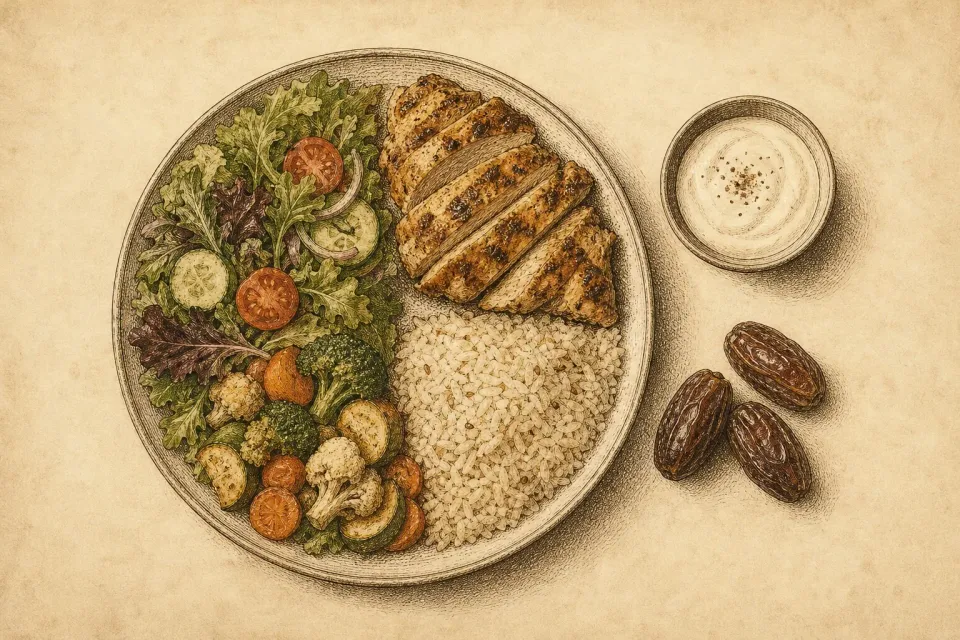
Healthy Gulf Food: The Plate Method for Kabsa and Mandi, Nothing Banned
You do not have to give up kabsa or mandi to eat in balance. Half the plate vegetables, a quarter protein, a quarter starch, with a hand measure and a guide to Gulf dishes.
7 min read
How Weight Loss Works: Calorie Deficit and a Safe Pace
One rule sits behind every healthy diet: a moderate calorie deficit. Here it is in plain language, with the safe pace of loss and five habits that make it easier to keep.
7 min read


