
Logging Meals and Handling Emotional Eating Without Obsessing
Writing down what you eat shows what you miss, but it can turn into an obsession. How to log without guilt, a three-step emotional-eating plan, and when to see a professional.
By Eslam Abdelrahman7 min read

In this article
- In short
- Why does food logging help?
- How to log without it becoming a burden
- When does logging turn into an obsession?
- Emotional eating: a three-step plan
- Stomach hunger or emotional hunger?
- A weekly review in three questions
- Frequently asked questions
- Do I have to log everything all the time?
- I ate emotionally. Have I undone what I did?
- When is emotional eating a problem that needs a professional?
- Before you start: when to talk to a doctor
- A notebook and tracking in a book
- Sources
Food logging, writing down what you eat, is one of the simplest tools for paying attention, and also one of the habits that most easily turns into an obsession: numbers, sums and guilt. Emotional eating has a similar face: you eat because you are upset, tired or bored, and then you judge yourself. This article is about both: how to log in a way that helps rather than enslaves you, and how to deal with emotional eating with a calm plan instead of punishment.
In short#
- A scientific review linked tracking food, movement and weight with greater weight loss, likely because when you write things down you see what you actually eat.
- Log straight after eating, and write information, not judgements: what you ate, how much, when, and how hungry you were.
- Two weeks of full logging is enough to begin; then come back to it when needed.
- For emotional eating there are three steps: name the feeling, wait ten minutes, do something from your list.

Why does food logging help?#
A systematic review of several studies found a consistent link between recording what you eat, how much you move and what you weigh, and greater weight loss. The reason is simple: when you write, you see. You see the third glass of karak, the handful of nuts that became three, the bite taken from your child's plate. Logging does not change your food by itself, but it shows you what you were not noticing, and that is enough to start changing it.
How to log without it becoming a burden#
- Write straight after eating, not at the end of the day. After a few hours you forget half of what you ate.
- Write the food and the amount in hand measures, the time and your hunger before eating. If you do not know the hand measure, see the Gulf plate method, and if you do not know the hunger numbers, see the hunger scale.
- Do not write judgements. "Ate two pieces of basbousa at five, hunger 3" is information. "I am a failure" is not.
- Two weeks of full logging is enough at the start. Come back to it whenever the scale stalls or you feel you are drifting.
- You do not need an app. A small notebook and a pencil, or the notes app on your phone.
An example line: "Lunch, 1:30, chicken kabsa: a fist of rice, a palm of chicken and half a plate of salad. Hunger before 7, after 4."

When does logging turn into an obsession?#
Watch for any of these signs:
- You feel intense anxiety if you miss logging a meal.
- You avoid eating with people because you cannot estimate what will be served.
- You judge yourself over every bite, or punish yourself with hunger.
- You worry about the numbers more than you benefit from them.
When that happens, ease off: log one meal a day, or stop for a week. Logging is a means, not a goal. And if the worry about food persists, talk to your doctor or a mental health professional.
Emotional eating: a three-step plan#
Not everything we call hunger is hunger. Emotional hunger arrives suddenly, asks for one specific food, and does not end with fullness. It is nothing to be ashamed of, and we all feel it. What matters is to recognise it when it comes:
Step one: name the feeling. Before you eat outside a mealtime, say to yourself: I am tired. I am upset. I am bored. Just naming it eases the urge.
Step two: wait ten minutes. Do not say "I will not eat." Say "I will eat in ten minutes if the craving is still there." Usually it settles.
Step three: do something from your list. Write a short list of five alternatives before the hard moment arrives: calling a friend, wudu and prayer, a short walk, a cup of tea without sugar, tidying something small. The list has to be ready before you need it.
And if you eat anyway, eat sitting down, from a plate and slowly, and do not punish yourself. The next meal is a normal one.
Stomach hunger or emotional hunger?#
Quick questions to tell them apart: did the hunger build gradually hours after the last meal? Would any food do, or do I want one specific thing? Where do I feel it: in the stomach or in the head and mouth? If the answers lean to the second, it is probably emotional hunger, and what you need is rest, movement, a chat or sleep. For the full table see the hunger scale.
A weekly review in three questions#
Once a week, on the same day, read what you wrote and ask yourself just three questions: which meal was the hardest this week? Which pattern repeated: late nights, screens, or being very hungry before eating? And what is the one small change I will try next week? Choose one change, not five. Look at what worked too, because the review is not a trial. Those five minutes are worth more than hours of arithmetic.
Frequently asked questions#
Do I have to log everything all the time?#
No. Two weeks of full logging is enough to begin, then log when needed: when the scale stalls or you feel you are drifting. The aim is attention, not accounting.
I ate emotionally. Have I undone what I did?#
No. One extra meal does not raise your weight in any real way; what raises it is deciding the week is lost and giving up. Note what happened as information, and go back to the next meal.
When is emotional eating a problem that needs a professional?#
If you eat very large amounts and feel you cannot stop, if intense guilt follows your eating, or if you turn to vomiting or harsh fasting to make up for it, see a doctor or a mental health professional. It can be treated, and it is not a lack of willpower.
Before you start: when to talk to a doctor#
This article is educational and is not a substitute for a doctor or a mental health professional. If you are pregnant or breastfeeding, under 18, have a history of an eating disorder, have diabetes and use insulin or blood-sugar-lowering medication, have heart, kidney or liver disease, take weight-loss medication, or are at a normal or low weight, talk to your doctor before changing how you eat. If you have had an eating disorder, do not begin detailed logging without a professional. And never stop a medication your doctor prescribed on your own.
A notebook and tracking in a book#
The 60-Day Weight Loss Plan has a tracking table, daily boxes and weekly review pages, and on day 31 you write a list of alternatives for emotional eating. But an ordinary notebook is enough to start today.
Sources#
- Burke LE, Wang J, Sevick MA. Self-monitoring in weight loss: a systematic review of the literature. J Am Diet Assoc. 2011;111(1):92–102.
The emotional-eating steps (naming, waiting ten minutes, the list of alternatives) are practical tools from the book, and we do not tie them to a specific study.
This content is educational and not medical advice. It does not replace a doctor or another qualified professional. We do not promise any result; results differ from person to person.
Subscribe to the Khutwa newsletter
New posts and a note when a new book comes out. No spam, and you can leave in one click.
You may also like
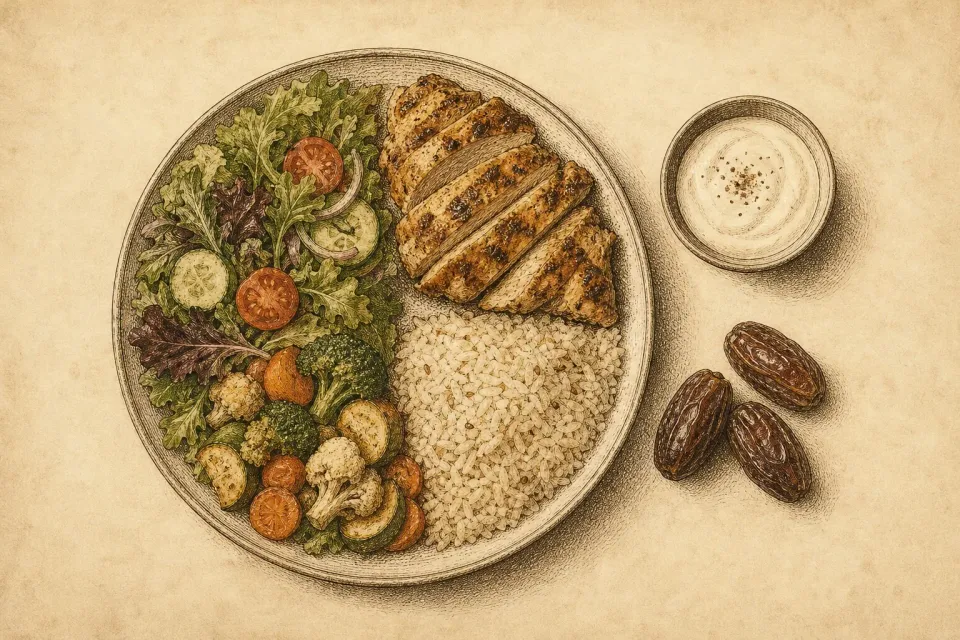
Healthy Gulf Food: The Plate Method for Kabsa and Mandi, Nothing Banned
You do not have to give up kabsa or mandi to eat in balance. Half the plate vegetables, a quarter protein, a quarter starch, with a hand measure and a guide to Gulf dishes.
7 min read
How Weight Loss Works: Calorie Deficit and a Safe Pace
One rule sits behind every healthy diet: a moderate calorie deficit. Here it is in plain language, with the safe pace of loss and five habits that make it easier to keep.
7 min read
The Hunger Scale from 1 to 10: Eat With Attention and Stop at Fullness
Ask yourself before eating: how hungry am I, from 1 to 10? We explain the scale, stomach versus emotional hunger, and five habits for eating with attention and stopping at fullness.
7 min read


