
The Hunger Scale from 1 to 10: Eat With Attention and Stop at Fullness
Ask yourself before eating: how hungry am I, from 1 to 10? We explain the scale, stomach versus emotional hunger, and five habits for eating with attention and stopping at fullness.
By Eslam Abdelrahman7 min read

In this article
- In short
- What does eating with attention mean?
- The hunger scale: a number before the first bite
- Stomach hunger and emotional hunger
- Five habits for eating with attention
- 1. Sit down, at the table
- 2. Slow down
- 3. One meal without a screen
- 4. On a plate, not from the bag
- 5. Pause in the middle
- Try this week
- Frequently asked questions
- Does eating slowly really help with weight loss?
- What if I cannot tell the two kinds of hunger apart?
- Should I always finish my plate?
- When it is bigger than a habit
- The "attention minute" in a book
- Sources
How often has your plate been empty before you could say what it tasted like? It happens to most of us: we eat in front of a screen, in the car, or standing in the kitchen, and then reach for more because the brain never registered that we ate. Mindful eating needs no special food and no money. It needs one simple question before you eat, the one the hunger scale is built on: how hungry am I right now?
In short#
- Give your hunger a number from 1 to 10 before you eat. Start eating at 6 or 7 and stop when you are back at 3 or 4.
- Not everything we call hunger is hunger: there is stomach hunger and emotional hunger, and each needs a different response.
- Three habits are enough to begin: sit down to eat, slow down, and put your food on a plate.
- These are practical tools for paying attention. They are not a diet and not strict rules.
What does eating with attention mean?#
Knowing that you are eating while you eat. It does not mean eating in silence or counting bites. It means three simple things: knowing whether you are hungry, slowing down a little, and noticing when you have had enough. These habits stay with you at any table in any country, and they complement the Gulf plate method: the plate decides what you eat, and attention decides how.
The hunger scale: a number before the first bite#
Before you eat, give your hunger a number:
| Number | How it feels |
|---|---|
| 1 – 2 | Completely full, stuffed |
| 3 – 4 | Comfortable, no hunger |
| 5 | Neutral |
| 6 – 7 | Clearly hungry. This is the time to eat |
| 8 – 9 | Very hungry, concentration is poor |
| 10 | Extremely hungry, you will eat anything fast |
Start eating at 6 or 7. People who wait until 9 or 10 eat fast and go past what they need. Stop when you are back at 3 or 4: comfortable, not stuffed. And if you find a 4 or lower while your hand is reaching for food, the hunger is not in your stomach, so ask yourself: what am I feeling right now?
This scale is a common practical tool, not a medical test, so do not worry about precision. The point is to get used to asking the question.
Stomach hunger and emotional hunger#
Not everything we call hunger is hunger. This table helps you tell them apart:
| Stomach hunger | Emotional hunger | |
|---|---|---|
| How it starts | Gradually, hours after the last meal | Suddenly, even soon after eating |
| What it asks for | Accepts any food | One specific food: sweet, crunchy or fried |
| Where you feel it | In the stomach: emptiness, rumbling | In the head and mouth: a craving, a thought that insists |
| When it ends | When you are full | Not when you are full, and regret may follow |
| What you actually need | A meal | Rest, movement, a chat or sleep |
Emotional hunger is nothing to be ashamed of, and we all feel it. What matters is to recognise it when it comes and give it what it actually needs. There is a step-by-step plan for emotional eating in Logging Meals and Handling Emotional Eating Without Obsessing.

Five habits for eating with attention#
1. Sit down, at the table#
Give eating one place in the home. No eating standing at the fridge, from the pot, or in the car. When eating is tied to the table, there are fewer passing bites that nobody counts.
2. Slow down#
The fullness signal needs time to travel from the stomach to the brain. Someone who finishes a plate very quickly never gives the body a chance to say: enough. The easiest way is to put the spoon down between bites, and to make the main meal longer than you are used to.
3. One meal without a screen#
We are not asking you to give up your phone at every meal. Start with one meal a day without TV or phone, and notice whether you feel full sooner and enjoy it more.
4. On a plate, not from the bag#
Put everything you eat on a plate first, even nuts and dates. A plate has an end; an open bag does not.
5. Pause in the middle#
Halfway through a meal, stop for a minute. Drink some water, look at what is left, and ask: am I still hungry, or am I continuing because the food is in front of me? You do not have to finish the plate. What is left can be kept for tomorrow.
Try this week#
Do not start with all five habits at once. Pick one, say "one meal without a screen", and do it every day this week. Then add the number question before eating. Over time you may find the questions come on their own. And if you miss a day, carry on from where you stopped instead of starting over.
Frequently asked questions#
Does eating slowly really help with weight loss?#
The idea is that the fullness signal takes time to reach the brain, so someone eating calmly is better placed to notice it. We do not quote a figure or a particular study here: this is a common practical habit, not a promise of a result, but it makes the meal calmer and brings you closer to what you actually need.
What if I cannot tell the two kinds of hunger apart?#
That is normal at the start. Use the waiting rule: tell yourself "I will eat in ten minutes if the craving is still there". Stomach hunger stays and grows gradually, while emotional hunger usually fades.
Should I always finish my plate?#
No. A plate is not a task to be completed. If you are full before it is empty, stop. What is left can be kept for tomorrow and does not go to waste.
When it is bigger than a habit#
If you eat very large amounts and feel you cannot stop, if your eating is followed by intense guilt, or if you turn to vomiting or harsh fasting to make up for it, this is too big for an article or a book to handle. See a doctor or a mental health professional; it can be treated.
This article is educational and is not a substitute for a doctor. If you are pregnant or breastfeeding, under 18, have a history of an eating disorder, have diabetes and use insulin or blood-sugar-lowering medication, have heart, kidney or liver disease, take weight-loss medication, or are at a normal or low weight, talk to your doctor before changing how you eat. And never stop a medication your doctor prescribed on your own.
The "attention minute" in a book#
In The 60-Day Weight Loss Plan there is a small exercise on every day called the "attention minute", applied to one meal and taking no more than a minute. Over the weeks those minutes turn into a habit. But what you read here is enough to start today without the book.
Sources#
This article contains no health figures. The hunger scale, eating slowly and eating without a screen are common practical tools, and we do not tie them to a specific study.
This content is educational and not medical advice. It does not replace a doctor or another qualified professional. We do not promise any result; results differ from person to person.
Subscribe to the Khutwa newsletter
New posts and a note when a new book comes out. No spam, and you can leave in one click.
You may also like

Logging Meals and Handling Emotional Eating Without Obsessing
Writing down what you eat shows what you miss, but it can turn into an obsession. How to log without guilt, a three-step emotional-eating plan, and when to see a professional.
7 min read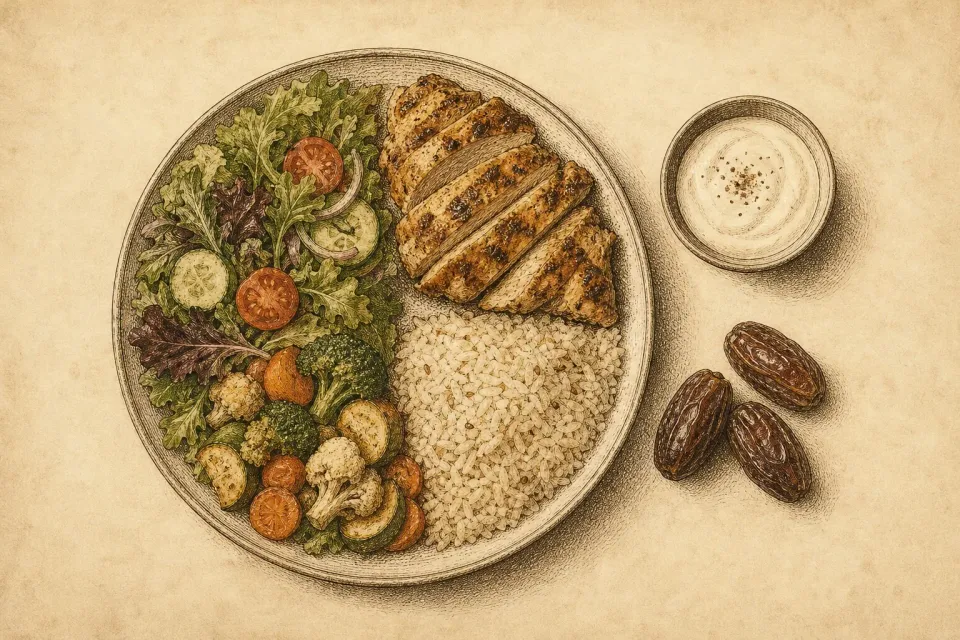
Healthy Gulf Food: The Plate Method for Kabsa and Mandi, Nothing Banned
You do not have to give up kabsa or mandi to eat in balance. Half the plate vegetables, a quarter protein, a quarter starch, with a hand measure and a guide to Gulf dishes.
7 min read
How Weight Loss Works: Calorie Deficit and a Safe Pace
One rule sits behind every healthy diet: a moderate calorie deficit. Here it is in plain language, with the safe pace of loss and five habits that make it easier to keep.
7 min read

