
How Weight Loss Works: Calorie Deficit and a Safe Pace
One rule sits behind every healthy diet: a moderate calorie deficit. Here it is in plain language, with the safe pace of loss and five habits that make it easier to keep.
By Eslam Abdelrahman7 min read

In this article
- In short
- How weight loss works: what is a calorie deficit?
- How big a deficit, and what is a safe pace?
- Why is faster not better?
- Do I need to count calories?
- Five things that make the deficit easier
- Frequently asked questions
- Is intermittent fasting or keto faster than other approaches?
- Is exercise alone enough to lose weight?
- What if the scale stalls for a week or more?
- Before you start: when to talk to a doctor
- From rule to habit
- Sources
Search for a "healthy diet" and you will find dozens of plans that look nothing alike: no carbs, no fat, strict eating windows. Behind all that variety sits one simple rule that explains how weight loss works. Once you understand it, every balanced eating plan you read about makes more sense, and you can tell what is doing the work from what is just marketing.
In short#
- Weight comes down when your body gets a little less energy from food than it uses. That gap is called a calorie deficit.
- Health guidelines suggest a moderate deficit of 500 to 750 calories a day. That corresponds to losing roughly half a kilogram to one kilogram a week.
- Slower than that is normal, and faster is not better.
- You do not need to go hungry or count every calorie. A well-built plate and a few small habits are enough.

How weight loss works: what is a calorie deficit?#
Your body needs a certain amount of energy every day to breathe, move and think. That energy comes from food, and we measure it in calories. Eat more than your body needs and the surplus is stored as fat. Eat a little less than it needs and it draws the difference from its stores.
Weight does not come down without this gap, whatever the diet is called. Intermittent fasting, keto and the Mediterranean diet all work for people who create a deficit with them, and none of them work for people who do not. The real difference between them is how easy each one is to stick to, not a hidden trick in any of them.
How big a deficit, and what is a safe pace?#
US health guidance suggests a daily deficit between 500 and 750 calories and a gradual loss of roughly half a kilogram to one kilogram a week, the same pace the NHS recommends. This is the pace that protects your muscle and that you can actually keep up.
There is also a floor. Adult weight-management guidelines use a range of 1,200 to 1,500 calories a day for women and 1,500 to 1,800 for men, adjusted for body weight. Going below the bottom of that range should only happen under medical supervision, and these limits do not apply to breastfeeding mothers, whose needs are different.
If your weight comes down more slowly than this, do not count it as failure. Bodies differ, and age, sex, sleep and medication all play a part. These figures are guideline ranges, not promises, and your own result may sit above or below them.
Why is faster not better?#
Very sharp drops take from muscle and water, leave you hungry and tired, and the weight returns at the first slip. A moderate pace is slower, but it keeps your body working and gives you time to turn the new routine into a habit. Weight lost through a habit stays off as long as the habit does. Weight lost through deprivation tends to return at the first family gathering.
Do I need to count calories?#
Not necessarily. Counting is accurate but tiring, many people drop it after two weeks, and it falls apart when you eat out. Two simpler methods create the same deficit without arithmetic:
- The plate method: half the plate vegetables, a quarter protein, a quarter starch. We cover it on the Gulf table in The Gulf Plate Method.
- The hand measure: a fist for starch, a palm for protein, a thumb for fats. Your hand scales with your body and it is with you wherever you eat.
If you like numbers, you can still use a calorie-counting app alongside, and the ranges above work as a reference.

Five things that make the deficit easier#
None of these lowers your weight on its own. They make holding the deficit less of a struggle:
- Protein. It keeps you full longer and protects muscle while weight comes down. A review in adults over 50 found that those who ate more protein while losing weight kept more muscle mass and lost more fat. You do not have to weigh anything: a portion of protein the size of your palm at each meal is enough.
- Vegetables and fibre. They are bulky and low in calories, and they slow digestion so you stay full longer. That is why half the plate is vegetables.
- Liquid sugar. Juice, sweetened karak and soft drinks add a lot of calories without filling you up. Changing your drinks is the easiest habit and the one with the biggest effect.
- Sleep. Short sleepers get hungrier the next day and lean towards sweets. In a trial where everyone followed the same diet, people who cut about an hour of sleep on five nights a week lost as much weight as the others, but a smaller share of it was fat. Seven hours is a reasonable target for most adults.
- Movement. The WHO recommends adults do 150 to 300 minutes a week of moderate activity, plus muscle-strengthening work on two or more days. Movement matters most for protecting muscle and keeping weight steady afterwards. For walking in the Gulf heat there is a full plan in Walking in the Gulf Heat.
Frequently asked questions#
Is intermittent fasting or keto faster than other approaches?#
The scale may drop more at the start, but part of that is water, not fat. Over the longer run fat only comes off through a calorie deficit, so pick the approach you can stick with without coming to dislike food.
Is exercise alone enough to lose weight?#
Movement is very useful, but its effect on the deficit is smaller than many people think. What you eat creates most of the gap, and movement remains essential for keeping muscle and keeping weight steady afterwards.
What if the scale stalls for a week or more?#
That is expected and happens to most people. Measure your waist, review your sleep and what you drink, and check you are still using plate portions. Do not answer a stall by eating below the limits above.
Before you start: when to talk to a doctor#
This article is educational and is not a substitute for a doctor. If you are pregnant or breastfeeding, under 18, have a history of an eating disorder, have diabetes and use insulin or blood-sugar-lowering medication, have heart, kidney or liver disease, take weight-loss medication, or are at a normal or low weight, talk to your doctor before changing how you eat or move. And never stop a medication your doctor prescribed on your own.
From rule to habit#
Understanding the deficit is the easy part. The hard part is turning it into habits that last. That is why we wrote The 60-Day Weight Loss Plan, an Arabic-language book that gives you one small habit per day, from water and the half-plate to mindful eating and walking. This article stands on its own for understanding the rule, and the book is there if you want the steps laid out day by day.
Sources#
- NHS. Obesity: treatment. nhs.uk/conditions/obesity/treatment
- ODPHP, U.S. Department of Health and Human Services. MyHealthfinder: Aim for a Healthy Weight. odphp.health.gov
- Jensen MD, et al. 2013 AHA/ACC/TOS Guideline for the Management of Overweight and Obesity in Adults. Circulation. 2014;129(25 Suppl 2):S102–S138.
- World Health Organization. WHO Guidelines on Physical Activity and Sedentary Behaviour. Geneva: WHO; 2020.
- Kim JE, et al. Effects of dietary protein intake on body composition changes after weight loss in older adults: a systematic review and meta-analysis. Nutr Rev. 2016;74(3):210–224.
- Wang X, et al. Influence of sleep restriction on weight loss outcomes associated with caloric restriction. Sleep. 2018;41(5):zsy027.
This content is educational and not medical advice. It does not replace a doctor or another qualified professional. We do not promise any result; results differ from person to person.
Subscribe to the Khutwa newsletter
New posts and a note when a new book comes out. No spam, and you can leave in one click.
You may also like
Logging Meals and Handling Emotional Eating Without Obsessing
Writing down what you eat shows what you miss, but it can turn into an obsession. How to log without guilt, a three-step emotional-eating plan, and when to see a professional.
7 min read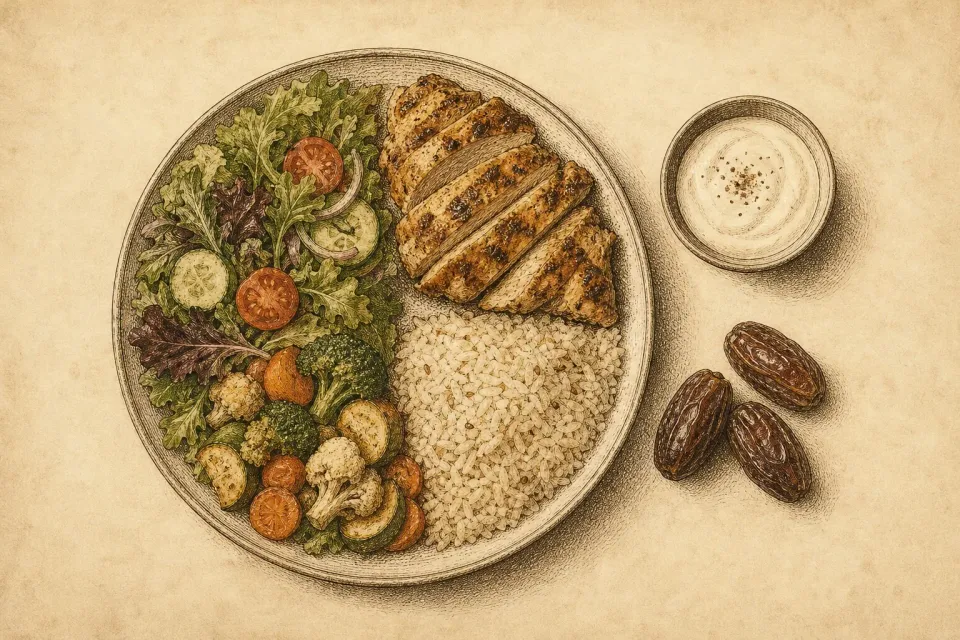
Healthy Gulf Food: The Plate Method for Kabsa and Mandi, Nothing Banned
You do not have to give up kabsa or mandi to eat in balance. Half the plate vegetables, a quarter protein, a quarter starch, with a hand measure and a guide to Gulf dishes.
7 min read
The Hunger Scale from 1 to 10: Eat With Attention and Stop at Fullness
Ask yourself before eating: how hungry am I, from 1 to 10? We explain the scale, stomach versus emotional hunger, and five habits for eating with attention and stopping at fullness.
7 min read


